Industry Insights · Medical Polymers & Silicone
Choosing medical silicone: LSR vs HCR
LSR and HCR are the two most basic forms of medical silicone, and they decide your process, your tooling and your viable volume — pick wrong and you drive up cost or simply cannot make the part.
The core difference: form dictates process
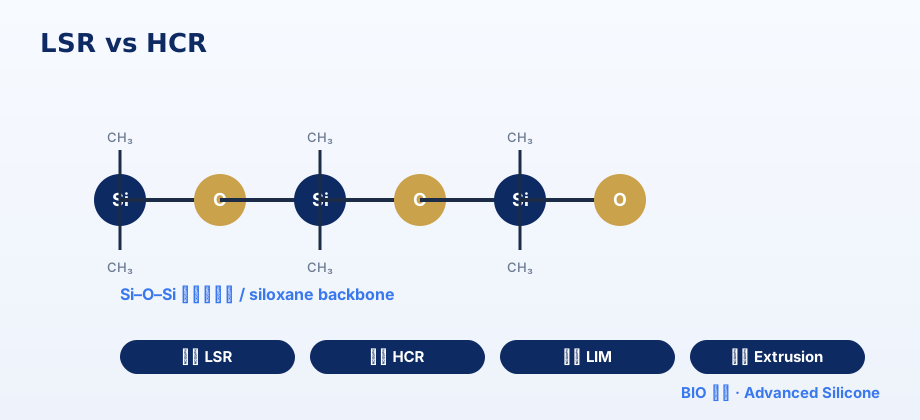
The chemistry is the same; the difference is form. LSR is a pumpable liquid; HCR is a solid gum that needs heat and pressure to flow. Form drives the molding process, tooling and volume fit.
| Dimension | LSR (liquid) | HCR (high-consistency) |
|---|---|---|
| Viscosity / form | ~100k–500k cP, flowable | millions of cP, solid gum |
| Typical cure | Platinum addition | Mostly peroxide, also Pt |
| Process | Liquid injection molding (LIM) | Compression / transfer, extrusion, calendering |
| Min wall | down to 0.3–0.5 mm | from 0.5 mm, better for thick |
| Volume fit | 100k+/yr, automated | low-mid volume, profiles |
| Tooling / equipment | LIM machine costly, high tooling | low equipment & tooling cost |
| Shrinkage | Pt <1% | peroxide 2–5%, Pt <1% |
| Typical parts | valves, O-rings, thin precision | tubing, sheet, thick parts, gaskets |
What each does best
- LSR: high-speed automated molding, thin/complex geometry, excellent batch consistency, minimal manual handling — best for high-volume precision;
- HCR: continuous extruded tubing/profiles, calendered sheet (0.5–3 mm), compression/transfer-molded thick sections, low prototyping cost.
Mapping to NuSil MED grades
In NuSil / Avantor nomenclature, MED-40xx/45xx/48xx are mostly HCR, while MED-50xx/59xx are LSR (representative ranges from training materials; verify against current TDS):
| Code range | Type | Typical use |
|---|---|---|
| MED-40xx | HCR elastomer | Molding / extrusion |
| MED-45xx | HCR (restricted) | Short-term implant |
| MED-48xx | HCR (unrestricted) | Long-term implant |
| MED-50xx | LSR elastomer | LIM molding |
| MED-59xx | LSR (restricted) | Class VI devices |
The BIO angle
FAQ
Which is more expensive, LSR or HCR?
It depends. LSR has high upfront equipment and tooling cost but low per-part cost at high volume; HCR has cheaper equipment and tooling, better for low-to-mid volume and prototyping.
Do thin precision parts require LSR?
Thin, complex, high-volume parts favor LSR, down to 0.3–0.5 mm. HCR can do it too, but with less precision and automation.
What about tubing and sheeting?
Use HCR — extrusion for tubing/profiles, calendering for 0.5–3 mm sheet.
Is LSR always platinum-cured?
Almost always platinum addition cure. Platinum is sensitive to amines, sulfur and some drugs, so drug-containing or special formulations need compatibility testing first.
Can you map my needs to a specific NuSil grade?
Yes. Send your device, contact duration, volume and durometer target, and we will match a MED grade, cure system and TDS.
Related reading
- Silicone, Silicone Oil, Silicone Resin: How They Relate, in 3 Minutes | BIO Insights
- Medical Polymers: Which Biocompatibility Tests Do You Actually Need? | BIO Insights
- Biodegradable Medical Implants: Reshaping Future Practice (Literature Brief) | BIO Insights
Note: an original analysis compiled from public industry information; figures and conclusions per official/original sources. Not investment advice.
Building in China's medical-device market?
From advanced medical silicone/polymers to material selection, regulatory and supply, BIO helps global and local partners move from selection to landed supply in China.